


The National Convention on the European Union in North Macedonia (NKEU-MK) in partnership with the Parliamentary Commission for European Affairs realized the Fifth Plenary Conference which was held in the “Boris Trajkovski” parliamentary hall. After official addresses from the high-ranking representatives from national institutions, the EU, the USA, and the Slovak Republic, two panel discussions were held on two topics: “Fundamentals in the European integration: rule of law and delivered reforms” and “How to deal with climate change and social consequences in agriculture, forestry and environment?”. NKEU-MK is a civil platform with a continuous dialogue structure to support the EU accession negotiations.
“In the last 5 years the National convention has given a significant contribution in preparing the country for EU accession. The working groups have made open and inclusive debate for EU integration possible, along with representatives from the civil sector, the government, civil society organizations, and individual experts in the fields. I am especially pleased that we have different representatives with opposing political opinions on all the reform-related issues,” Said Eric Meyer, Deputy Chief of mission at the US Embassy. He highlighted that in partnership with the Slovak Government, the American Government supported the NCEU-MK and laid the groundwork for a successful negotiation process together.


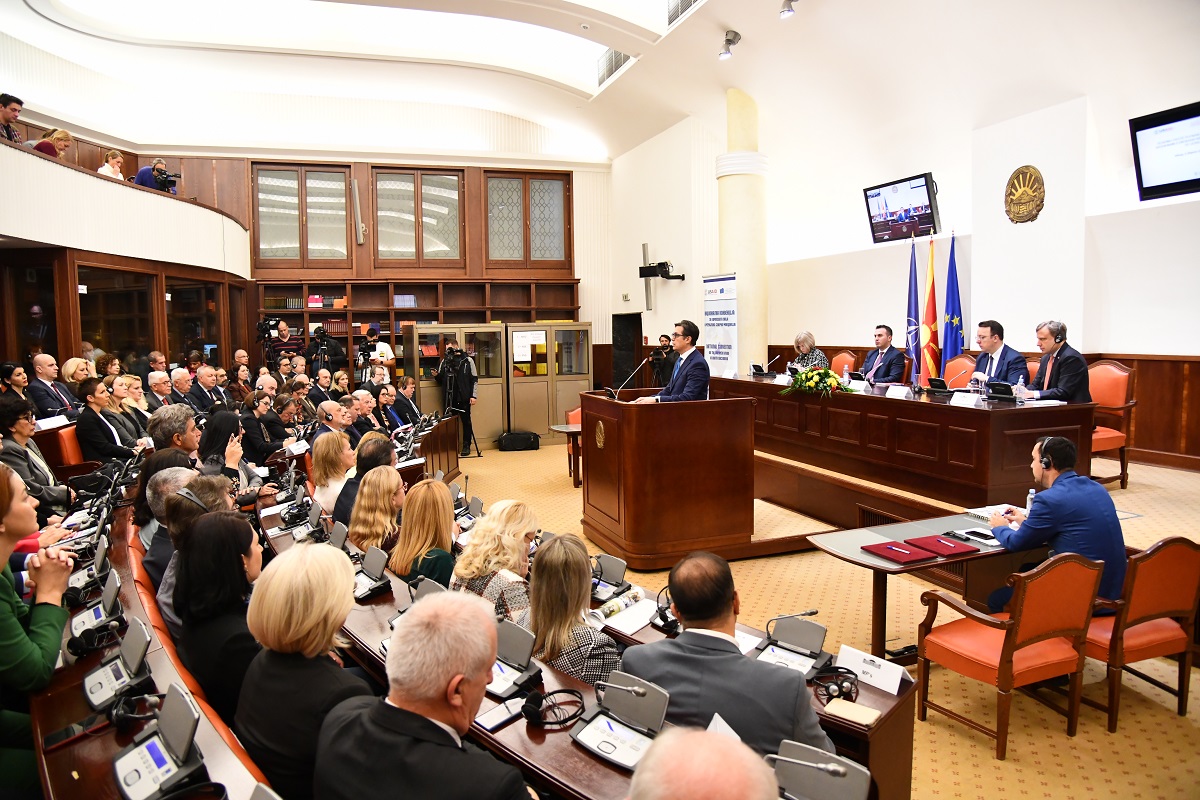


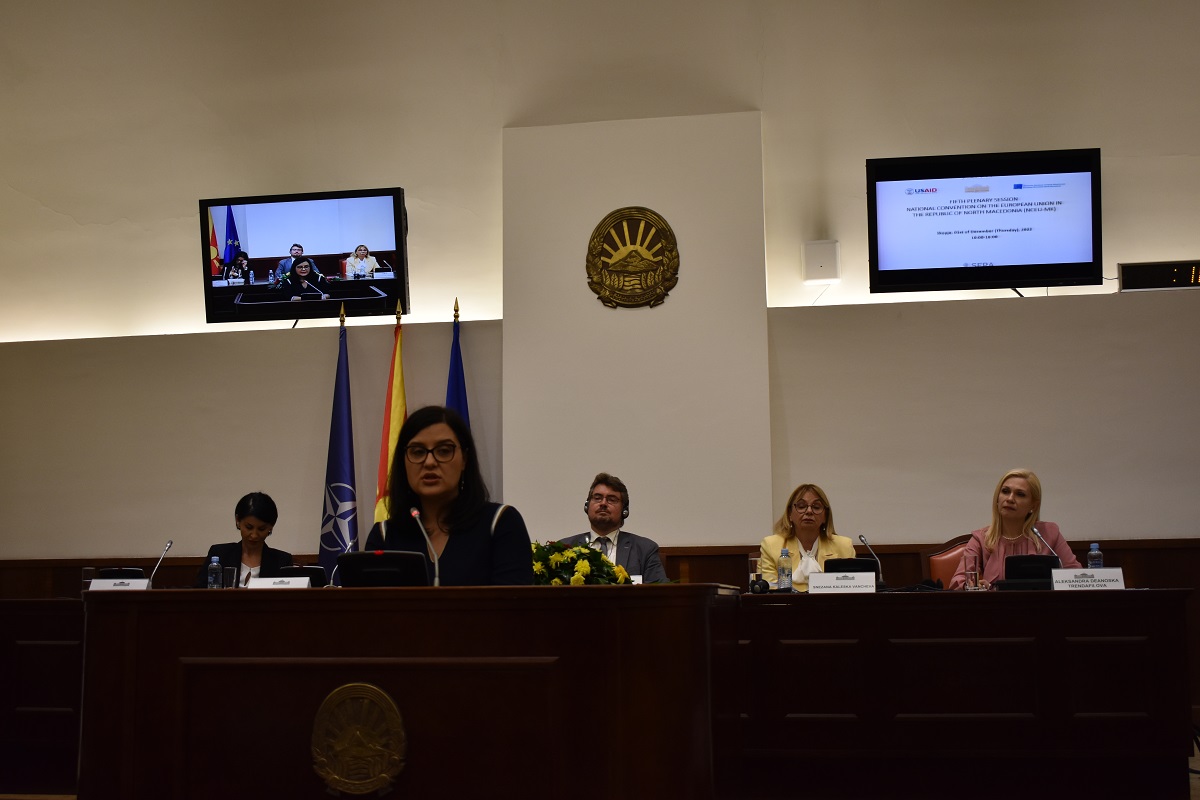
The Slovakian ambassador Henrik Markus also emphasized the importance of the National Convention, which “became an important tool in preparing the country for the EU accession negotiations”, by offering debates including the national actors – the government, parliament, civil society, the business and academic community, and the foreign experts as well, especially from Slovakia, who share their experiences on the way to the EU.
The president of the country, Stevo Pendarovski, who gave an introductory address, said that changes and reforms in the country shouldn’t be initiated just to satisfy the European bureaucrats, but to fundamentally change our society and the work of our institutions as well.
“How fast he EU integration process for us will be depends on Brussels as well as the other member-states, but it mostly depends on us.” Only by getting out of our comfort zone of political declarations will the process on accession to the EU have the transformative effect that we more than need, said Pendarovski.
“Subjects from the entire political spectrum need to come together for the national interest and focus on delivering the needed EU reforms. Of course, this doesn’t mean that the opposition should stop with its work, because its role is to ask questions, to doubt, but also to offer solutions,” said the EU Ambassador, David Geer.
Arber Ademi, the president of the parliamentary commission for EU affairs, mentioned that it is necessary to have a consensus when it comes to the strategic determination of the country, in context of the expected changed in the constitution. But his colleague Aleksandar Nikolovski, from VMRO-DPMNE, said that the government should’ve thought about building that consensus earlier.
“Macedonia has its own unique way of entering the EU, different from other members. You will agree that this type of pressure from Greece at first and now Bulgaria, hasn’t been present in any other country”, pointed out Nikolovski.
At the panel discussion, when asked about how we deal with hybrid threats, especially taking into account that a lot of schools got reports of planted explosives, the minister of Internal Affairs, Oliver Spasovski, answered that in that context are also the reports of placing explosive devices in Skopje secondary schools and that the matter is treated with maximum seriousness in the Ministry of the Interior, although “the common goal of everyone is to produce fear in society”.
“All the reports are treated with maximum seriousness by the Ministry of Internal Affairs, and all precautions are taken: after the evacuation, a protective perimeter is provided and there is an anti-terrorist inspection of the facilities and the environment, while traffic is being limited and diverted North Macedonia is not an exception for hybrid attacks, and so-called false bomb alerts. On the contrary, this type of attacks are a common thing the neighboring countries are massively exposed to – such as: Serbia, Croatia and Montenegro, along with more distant ones, like New Zealand, Canada, the USA, Germany, etc., he said.
Apart from the politicians and the diplomats, at the Convention in the parliament, judges, prosecutors, professors and other Macedonian and Slovak experts on justice and the environment, ecologists, representatives of the civil sector relevant to both topics also participated. Almost all of them came to the conclusion that the rule of law should be a priority for North Macedonia, which generally has well-tailored laws in all the spheres, but the problems is that they aren’t consistently implemented. With the plenary conference, as concluded by the national coordinator of NCEU-MK, professor Mileva Gjurovska, the five-year cycle of the work of the National Convention was completed, which has adopted over 500 recommendations so far, held 44 sessions and included more than 2000 participants which represented the relevant institutions, namely civil associations, the business sector, the academic environment, trade unions, organizations of employers and others, in five working groups working on the chapters on justice, agriculture, social politics and environment.