


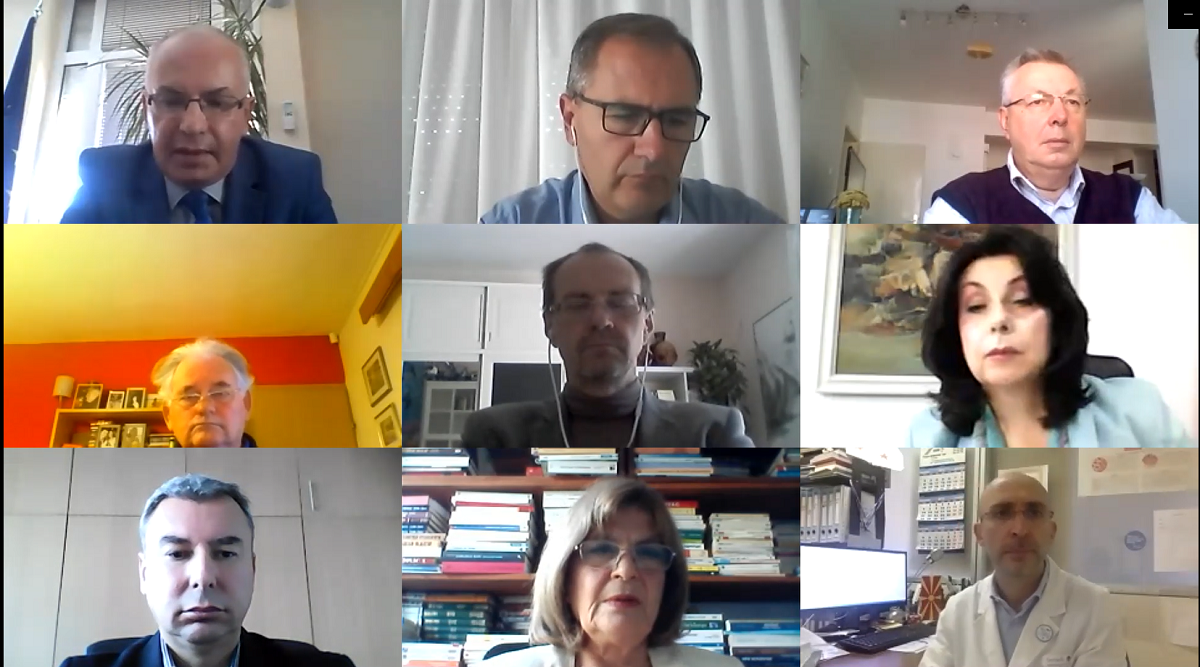
The pandemic has changed the entire functioning of society and revealed weaknesses in functions of many sectors. Security and the security sector, including here the public and private security systems, have become extremely important in creating the “new normal” which is necessary to move forward. This is the conclusion of the debate “The pandemic and security: How to proceed?”, from the session of the National Convention for the European Union in the Republic of North Macedonia (NCEU-MK) prepared by the Working Group – 4, Chapter 24 of the accession negotiations for EU membership, which was held on 21.10.2020.
The National Coordinator of NCEU and President of the European Movement, Mileva Gjurovska, emphasized that one of the issues is that despite the urgency of measures to protect against Covid-19, other risks were not reduced even a little, such as the massive number of illegal immigrants, human trafficking, organized crime, as well as other phenomena with a high security risk.
– Efforts are being made to develop organizational practices in order to be able to move on, in order to live with the pandemic. The measures that were taken at the very beginning of the pandemic, when analyzed from this distance, say that it was not predicted that the pandemic would last long, but it is continuing and it is not known how much longer it will last. Apart from health risks, which have primary importance, and the strengthening of healthcare systems, a particularly vital area security are the risks at state borders, because many countries have put the emphasis in protective measures on border security. Then safety of work environments, schools, kindergartens, public transport and other areas. Analyzes in other countries show that there are entire professional teams in all of these segments, which are starting to work on developing measures for greater security, Gjurovska pointed out.
State Secretary in the Ministry of Internal Affairs (MVR), Magdalena Nestorovska, said that the pandemic caused an increase in a certain type of crime and Europol’s analyses, as well as our own analyses, surely indicate that criminals did not retreat during the pandemic, but only changed their way of acting.
– The most prevalent are the crimes related to compliance with health regulations, and the prohibitions related to the prevention of Covid-19, and an increase was also observed in serious thefts and acts with elements of violence in certain time intervals. Considering the increased use of the Internet, and the increased dynamics of social media, in conditions of social distancing, the risk of computer crime is markedly increased. During this period, online trade and online payments have increased significantly, and this can lead to risks for the security and protection of users’ personal data, data from their payment cards and bank accounts, Nestorovska pointed out.


According to her, the increase in child sexual exploitation via the Internet, at the level of the European Union, is worrisome, which imposed the need for constant monitoring and taking preventive measures.
– This increase is due to the isolation of children that has increased during covid isolation, with greater exposure to the Internet, and in many cases not enough supervision by parents. Their detection in these conditions is difficult, and often they are not visible to the services, said Nestorovska.
She pointed out that the presence of disinformation, which is a key feature of threats during the crisis, is often associated with hybrid threats that, in their broader spectrum, aim to undermine public trust in government institutions.
– For those reasons, while defining the pandemic, we can conclude that it is an initial coping with health risks but also with fake news, underlined Nestorovska.
This is a tsunami in healthcare, said today Ivo Boskovski, consultant gastroenterologist of the Foundation of the University Polyclinic “Agostino Gemelli” from Italy.
– The fight is now being fought in hospitals. The situation is not good right now in Italy because it’s mid-October and we’re already overcrowded. The most optimistic expectations are that the vaccine can arrive in March, so we won’t get rid of masks for at least a year and a half and they should become part of our culture. The Italian government has an obligation to impose their wearing and physical distance without reducing the quality of life, otherwise it will be a disaster, Boskoski said, adding that on a daily basis there are now 11,000 new infections in Italy.
– The virus is transmitted very easily during this period, especially due to wet conditions and staying indoors. For Italy, a second closure will be an economic disaster, and the country is already in an economic crisis. Right now we have almost 11,000 infected a day and we don’t have enough for all places, so we send the lighter cases to hotels where new staff are being recruited. For years, healthcare costs have been cut and what we see now is a product of those restrictions with practically every budget. In March, when the epidemic broke out, we literally had no masks to fight it, so a large number of doctors got infected and died, as well as nurses and technical staff,” said Boskovski.
According to him, as a result of the overloading of the health system, more people in Italy are dying now even from trivial diseases, such as appendicitis, heart attacks, intestinal obstructions, etc., which under normal conditions would not have led to this outcome, because it could to be answered accordingly. Now, due to the fear of getting infected or the inability to pay attention to doctors, their healthcare is suffering.
– A long waiting list is being created for examinations and for oncology patients who need to go for control, so as a healthcare system we are back to the eighties and nineties. It is also a problem to do a simple blood count, so now all other diagnoses are neglected and we will have an acute picture for the next few years because we will not be able to rehabilitate those cases. The diseases of patients who do not go for regular check-ups have also progressed. On the other hand, there are false news reports that there is no epidemic, which cause enormous damage to the entire situation and to the medical staff, says Boskovski. According to him, the Italian experience is that the second wave brings patients who are younger, who have been to celebrations, birthdays, weddings, etc.
– We need support from the Government and all institutions of the state. If the Italian government had made a decision to make it mandatory to wear masks since April, we would not be in this situation. It is one of the most effective protective means. It is enough to wear a surgical mask in order not to transmit the virus, which is cheap and accessible to everyone. Now that measure is being introduced in addition to the curfew, Boskovski said.
Juraj Mesik from Slovakia, a specialist in global trends and risks, and a former senior specialist for social development at the World Bank, made a comparison with the handling of the pandemic in countries in Europe.
– Your story of dealing with Covid-19 is very different from the story in Slovakia. The Slovakian story essentially started with success and ended with failure. We successfully managed the spring wave, we ended that wave with five deaths per million inhabitants, which was the lowest rate in Europe and we still have the lowest death rate. But we are on the wrong trajectory. The numbers are an indication that the right policies are very important in dealing with the pandemic. The fact that we managed the first wave of the pandemic is not a coincidence, but the result of active policies, which were based on science, Mesik says.
According to him, when their Government began to believe that the pandemic was disappearing, it applied policies that led to a harsher autumn wave.
– There was a similar development of events in the Czech Republic, but the situation in them is worse, unlike the spring wave. In Slovakia, there were also anti-covid demonstrations, demonstrators attacking the Government with stones, which shows the stress in society, even though we have the lowest rate of deaths from Covid in Europe, the Slovakian expert pointed out.
He predicts that in the autumn and winter months the situation will get worse everywhere. – The fundamental obligation facing governments around the world is to save lives. It is possible to a significant extent, but the way to do it is very politicized and it is necessary to balance preserving the lives of citizens and saving the economy, he assesses.
He believes that preventive measures everywhere in Europe in the first phase of the pandemic have shown results.
We now want students to go to school and people to go back to work. It makes no sense not to wear masks, due to the misinformation circulating on the Internet, physical distance, limiting grouping, additional protection of vulnerable groups is needed. If there is a complete closure, that is, a complete quarantine, the economies should consider another way of working, for example, five days of work and nine days of closure. It has the potential to help prevent the spread of the virus. The second way is active prevention, for the entire population, or at least what can be done for the risk categories and important professions, says Mešik and recommends that the population massively use the mineral Zinc and vitamin D, which have proven to be crucial in strengthening immunity.
He predicts that after the pandemic, i.e. in 2021, provided the epidemic ends with a successfully developed vaccine, the world will move from a health crisis to an economic-political crisis.
– However, every crisis also brings opportunities, one big opportunity is reforming health systems and their focus from treating diseases to prevention of diseases and active health support, which is another opportunity to save lives. The crisis has shown that societies are very vulnerable. This is a stress test, not a real disaster, and an opportunity to build more adaptive societies after this, he said.
Regarding the migration of doctors from the region to Western Europe, mostly to Germany, during the pandemic, he says that doctors cannot be forbidden to move freely and work in other countries, but recommends the authorities a financial incentive.
– What can be considered is to create a financial program that will allow to compensate the medical personnel to increase their salaries, so that they do not have a strong financial incentive to migrate, he says.
Trpe Stojanovski, professor at the Faculty of Security, UKLO Bitola, said that in these conditions of a pandemic, the Balkans is presented as a rather vulnerable environment, where rather tragic numbers show that we are facing an invisible enemy, he is here, however, we cannot recognize him and we cannot position ourselves qualitatively in terms of reducing the consequences arising from it.
Magdalena Lembovska from Eurotink emphasized that now more than ever it is imperative for the Government to establish policies and implement measures for the vulnerable and marginalized to have equal access to all mechanisms for medical services, education, poverty reduction, access to other forms of social inclusion.
– The pandemic has revealed worrying gaps in the capacity of central and local government to effectively support vulnerable, socially excluded and marginalized groups. The pandemic has shown that trust in public authorities is essential for the effective implementation of measures to deal with the infection, says Lembovska.