



International Conference
“How to reach quality and responsibility within judiciary: Legislation and good practices”
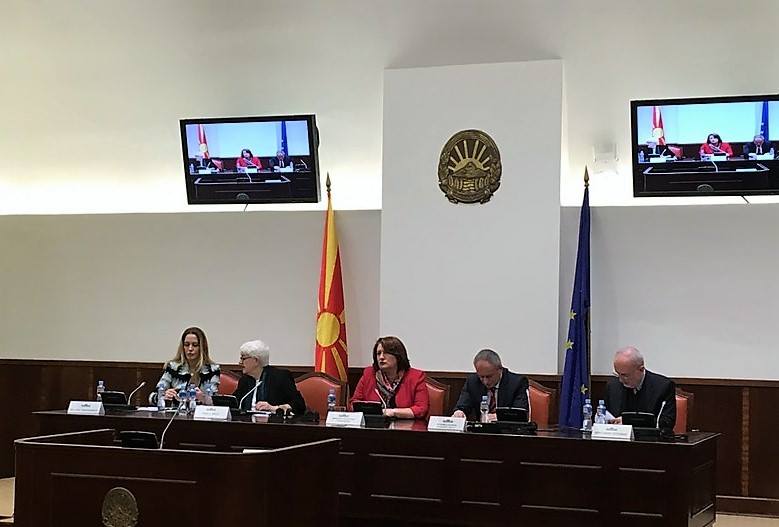
Premises: Boris Trajkovski Hall of the Assembly of the Republic of Macedonia.
Participants: Bujar Osmani (Deputy Prime Minister for European Affairs), Sonja Mirakovska (Head of the Legislative Committee of the Macedonian Parliament),
Mileva Gjurovska (President of the European Movement in the Republic of Macedonia and Coordinator of the NCEU-MK), Mirjana Lazarova Trajkovska (Former judge at the European Court of Human Rights in Strasbourg), Nuala Mole (AIE Center from Great Britain), Biljana Braithwaite, Program manager for the Western Balkan, AIRE Center London, Dragoljub Popovic (Former Judge at the European Court of Human Rights in Strasbourg), Osman Kadriu (Judge at the Constitutional Court of the Republic of Macedonia) and Elena Andreevska (Professor SEE University Tetovo).
Topic/discussion:
On the initiative of the expert team of WG 3 it was decided that an International Conference will be held in the context of affirmation of the Chapter 23 i.e. the National Convention of the EU in the R.Macedonia. Taking into account that in that same period there was other ongoing Conference in Skopje related to the independence of the judiciary.
This initiative was supported by the EMRM and the Conference was held on 15th March 2018. It was very insightful event and great occasion to share experience between participants from different countries from Europe on the topic of the judiciary reforms. The event attracted attention from the media, hence its media coverage is on very satisfactory level.
“Politics has no right to interfere in the processes of exercising the rights and freedoms of citizens, contrary to the right to protect them from politics. The independence of the judiciary is possible in societies where the legislative and executive authorities do not take part in the appointment of public judges and prosecutors, “said Mileva Gjurovska, President of the European Movement in the Republic of Macedonia and coordinator of the NCEU-MK, opening the yesterday’s conference at the Boris Trajkovski Hall – Assembly of the Republic of Macedonia.
“The quality of the judiciary, Gjurovska said, is not achieved by replacing judges with some” more appropriate “candidates, but by ensuring a greater autonomy of the judiciary system and an adequate law applying.”
Deputy Prime Minister for European Affairs Bujar Osmani stressed that the reforms in the judiciary are a priority envisaged in the Government’s plan known as “The 3-6-9” and he expressed a hope that those reforms will deliver the expected changes in the legal environment in the country.
– “The essential changes in the judiciary are a basic precondition for creating a fair, independent and efficient judiciary, which is a prerequisite for building a just, democratic and modern society. Without substantial progress in the judiciary, we cannot expect social, economic or political progress”, said Osmani.
Moderator of the first panel of the conference was Mirjana Lazarova Trajkovska, a former judge at the European Court of Human Rights in Strasbourg. An expert presentation was given by Nuala Mole from AIE Center from Great Britain, who spoke about “Quality and responsible judiciary in the United Kingdom”.
Dragoljub Popovic, a former judge at the European Court of Human Rights in Strasbourg, spoke on the topic: “The practice of the European Court of Human Rights on the importance of a quality and responsible judiciary”, and Osman Kadriu, the Constitutional Court of the Republic of Macedonia’ judge expressed his opinion about “The right as a condition and presumption for the realization of human rights”.
The guest lecturer Biljana Breitwait, the director of the Western Balkans at the AIRE Center, spoke about the experiences of the AIRE Center in London for Building a Quality and Responsible Judiciary in the countries of the Balkans “.
Elena Andreevska, a SEEU law professor delivered a speech about “The Road to an Independent Judiciary “.
According to Mirjana Lazarova Trajkovska, only a responsible and quality judiciary can respond to the challenges it is subjected to by the political authority and the quality of the judiciary is reflected in good quality court decisions.
Sonja Mirakovska, the head of the Legislative Committee of the Macedonian Parliament, also addressed the audience. In her speech she pointed out that Parliament is obliged to produce good quality laws, but that obligation is often overlooked. It is even more important, Mirakovska said, how those laws are then implemented by the relevant institutions and stressed that without a high-quality judicial power there is no democracy.
Noula Mole from Great Britain explained the British judicial system in which there is no profession of a career judge as judges are appointed from among the distinguished and elite lawyers. According to Mole, the problem of corruption has been overcome in the past since the rule was established for the judges to be able to have high salaries and for a judiciary to be deemed valuable profession by the British society. “Today a high-ranking judge earns up to £ 250,000 a year, and they are giving up even higher incomes as lawyers because to be a judge today in the UK is prestige and challenge, and earnings are not a primary motive for a judge.”
Constitutional Court Judge Osman Kadriu stressed that if the state does not provide legal mechanisms, then we do not have no guarantor of the civil rights in a society. According to him, in order to overcome the problems in the country we need to provide a perfect judiciary. He reminded that today in Macedonia and in the judiciary and in the prosecution we have people who are very much incriminated.
“The problem is in the position of the judiciary in which the antidemocratic, unlawful conduct reigns.” In the process of the appointment of the judges, now only four formal criteria are perceived – the candidate is supposed have a Law school diploma, to have passed a bar exam, to be a Macedonian citizen and to have appropriate experience but it is deemed unnecessary that he or she should also enjoy a reputation and, in particular, to be a prominent lawyer, according to Kadriu. “Those are not just empty words, they represent a constitutional obligation.” says Kadriu.