


Media regulation or self-regulation, as well as whether online media should be included in the legal framework, were among the key topics discussed today (March 16) at the online session on Chapter 23, dedicated to fundamental human rights. The title of the webinar, which was attended by about 60 participants, mainly in the field of justice and media, was entitled “Freedom of expression against defamation, insult and hate speech,” organized by the National Convention for the European Union in North Macedonia, NCEU -МК.
Experts said that the fundamental rights represent a key segment of Chapter 23. They are gaining even more importance in the new negotiation methodology (along with the judiciary and the fight against corruption) forming the first cluster of so-called “Fundamentals”.
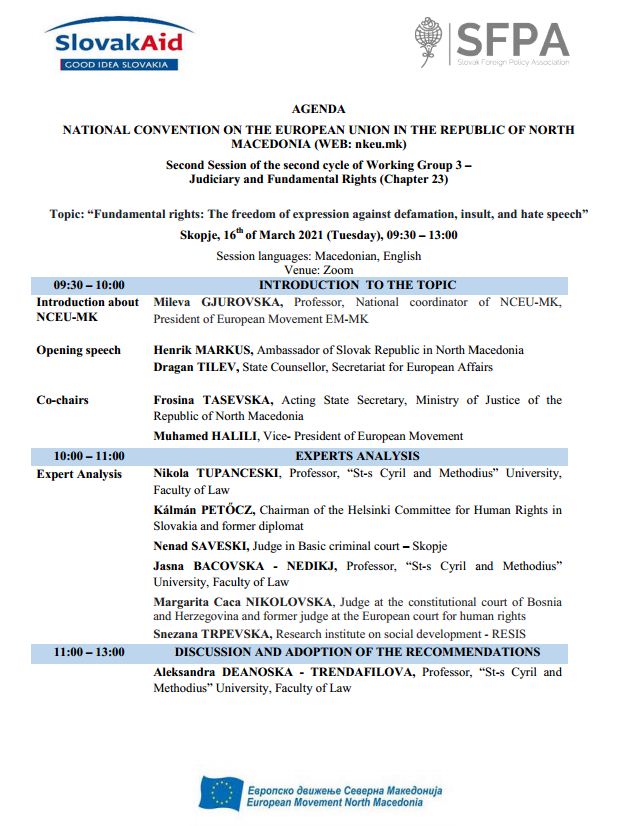
Professor Mileva Gjurovska, National Coordinator of NCEU-MK and President of the European Movement EM-MK, said that this is a wide area of rights and freedoms that should be implemented in the daily practices of citizens for which their affirmation, their weaving in national legislation and building mechanisms for their implementation.
– This is the first session dedicated to fundamental rights, so access to these rights is a basic condition for further accession to the EU. We start from the first chapter, because human rights have a universal character – said prof. Gjurovska.
The Ambassador of the Slovak Republic in Skopje, Henrik Markus, said that “the Government of North Macedonia is striving to implement European values and that should be welcomed.” He stressed that the European Union is facing the battle with Covid 19 pandemic, and that EU is working on the concept of a new Union in the future.
Dragan Tilev, State Adviser in the SEA, reminded that the country has been in the process of integration for more than 25 years.
– We are constantly going through reforms and changes, we are adapting to new acts and institutional reforms. The political goal is EU membership, but our primary goal is respect for human rights. “Last year was a year of success and disappointment – we became a member of NATO, but we failed, or the EU did not agree on the conditions under which the country should start negotiations with the Union,” Tilev added.
He informed that at the beginning of 2021, the Government adopted Plan 21, and recently a specific program “Europe at home”, with the basic goal of bringing Europe to us.
– When you are in the process of reforms, it is wise to have a plan. Regardless of the new methodology, we are ready to open the chapters – underlined Tilev.
In Macedonia, over one million citizens actively use the Internet, added Tilev, which, according to him, is a huge number. “Spreading hate speech through social media is like shooting at mobile targets, and you do not know which one will be hit,” he warned.
The professor from the Faculty of Law at UKIM, Nikola Tupancevski reminded that the slander and insult from 2012 are regulated by a special Law on Civil Liability for Defamation and Insult.
Honor and reputation are a serious legal norm, and they are a criterion for the democratic capacity of each state. Macedonia has started an autochthonous solution – a special law to regulate defamation and insult. Is this approach the best solution in editing this issue? We are working on a new criminal code, because we believe that the old one should not be repaired, but a thorough revision is needed, so maybe we should consider revision in this area as well – said Tupancevski.


Kálmán Petőcz, chairman of the Slovakian Helsinki Committee, underlined that his view of human rights is broader than that contained in the law.
– Freedom of expression is not absolute, and it has certain legal restrictions. Why is it under legal restrictions? Where is the line of demarcation between freedom and hate speech or defamation, Petőcz asked, noting that sometimes it is very difficult to draw that line of demarcation.
According to him, the restrictions on freedom of expression are reasons why we should protect political freedoms.
He emphasized the political culture of the elites, and then what is the purpose, motive or method of exercising freedom of expression.
Nenad Savevski, a judge in the Basic Court said that it is very important for public prosecutors and judges to be in good shape to be constantly aware of the danger of this type of crime, both in sanctioning and restitution of victims. He pointed out that the judiciary is the target of these attacks, and therefore the independence of the judiciary should be protected.
“Frosina Tasevska, State Secretary at the Ministry of Justice, said that the issue of attacks on journalists also plays an important role, with the EU seeking to clear up the events.” The public broadcasting service is also monitored, and efforts are made to provide a mandatory legal minimum for the financing of the Macedonian service. She underlined the five-year strategy for development of MRT and pointed out as important issues the Assembly to elect the composition of the Council for Audiovisual Services and the Council of MRT.
Jasna Bacovska Nedic, a professor at the Faculty of Law, pointed out the Bangalore principles, ie visibility of justice.
-Unfortunately, this has been neglected in our country, even on an academic level. We are late with the separation of powers, so the judiciary is doing nothing to improve the trust of the citizens, of which only 2 percent trust the courts. Judges are being fired these days, which is an attack on the judiciary. How can the judiciary restore trust? Principle of transparency, publicity in stages of proceedings, publication of verdicts, cooperation with journalists, establishment of court journalism, journalists who know the problem – said the professor from UKIM.
Snezana Trpevska, from the Institute for Research on Social Development, spoke on the question of whether there should be regulation for online media. She informed that the prevailing view in the media is that online media should not be subject to legislation. He pointed out that the AJM initiative was successful and a Register of 140 registered professional online media was created.
Mirce Adamcevski, the chairman of the Commission at the Ethics Council, underlined that we need much more media literacy, but that it does not turn into media censorship.
According to Adamcevski, there are very few independent media, and that they are mainly in clientelistic relations.
– We receive many complaints from plaintiffs for defamation and insult. We are not judges, but whether the product meets ethical and professional standards. According to the statistics of the Complaints Commission, the most numerous violators of the Code are the online media. As many as 91% of the media outlets complained about are online media. We are against the regulation of online media so as not to jeopardize freedom of expression. We believe that there are a lot of laws that can fight the irresponsible media. Our impression is that the courts and prosecutor’s offices are not doing their job, so it is easiest for them to regulate the media – underlined Adamcevski.